
Economic issues in West Bank and Gaza Strip
Despite improvements achieved at the end of 2010, the Palestinian economy suffered from structural weaknesses and institutional unsustainability.
Restrictive measures, violent confrontations and war-like conditions accentuated by almost 40 years of occupation, kept the productive sectors of the West Bank and Gaza strongly suffering from economic contraction and financial dependency on donor supported public sector spending.
In 2010, the unemployment rate in the West Bank was 17.8% but in Gaza soared to 38.6%. Almost 50% of the Palestinian households lived below the poverty line of $2 a day, and investment was virtually non-existent.
In order to promote the economic recovery, the Palestinian Authority delivered on the broad economic policies in the Palestinian Reform and Development Plan (2008-10).
That Plan addressed, in particular, the consolidation of the public finances as well as the support to small-scale infrastructure development projects.
However, the institutional framework for economic governance remained too fragmented to be able to implement the Palestinian Reform and Development Plan comprehensively.
On the one hand, a number of capable institutions, such as the Ministry of Finance (MoF), the Palestinian Central Bureau of Statistics (PCBS), and the Palestinian Monetary Authority (PMA), were established at a central level to accompany the economic recovery. On the other hand, several institutions continued to operate with weak capacity.
Main challenges underlying economic development
The Palestinian development efforts thus face multiple challenges, whereby recovery and reconstruction must proceed under:
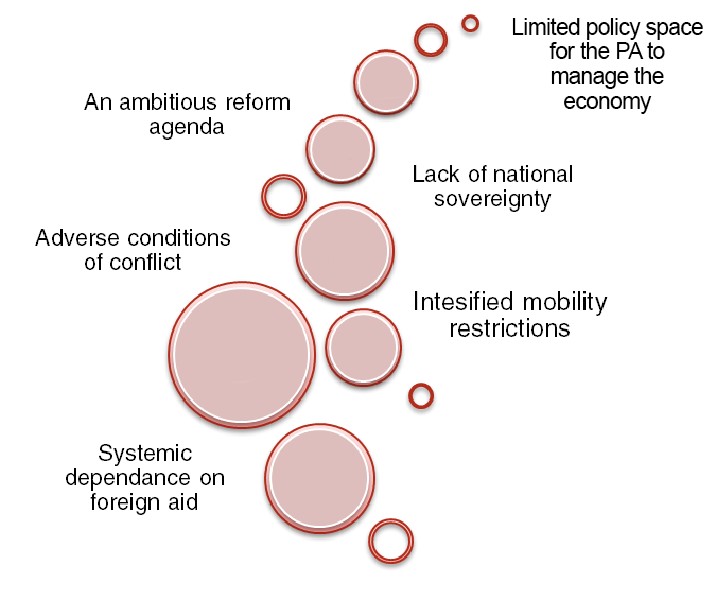
The Ministry of National Economy (MoNE) as a leading ministry, was appointed with the task of building a free and competitive economy through close cooperation between a competent public sector and a pioneering private sector.
The political mandate addressed the need to develop domestic capacities and resources by creating an environment attracting investment, and laying the foundation of sustainable growth and development by eliminating the dependency on external aid.
MoNE among other Ministries was entrusted with the tasks of providing essential economic stimulus to alleviate poverty, rebuilding business confidence and attracting private sector investment, helping the private sector build a vibrant, knowledge-based economy capable of producing goods and delivering services that could become competitive in both domestic and international markets.
The Project: strengthening the capacity of MoNE as a leverage to Palestinian economic recovery
n March 2013, an international consortium led by Eurecna S.p.A. and supported by the Centre for Continuing Education (CCE) of the Birzeit University and Benà for Institutional Development was awarded the coordination of the project EuropeAid/132690/C/SER/PS aimed to improve the MoNE’s organizational and human resources capacity:
by reinforcing procedures, operations, management, monitoring and quality control capacity.
by strenghetening human resources management system and skills development.
Actions realized
- Upgrading and implementation of best practices in Human Resources, Management procedures and mechanism within the MoNE;
- Establishment of effective performance management practices;
- Establisment of a Monitoring & Evaluation system and quality control measures;
- Establishment of a training centre supporting changing behaviour toward knowledge transfer;
- Establishment of quality management system, strengthening change in organizational behavior, culture for quality system organization, and focus on HR values and ethical standards.
The journey of the “orchestra”: an insight on project life
“If I were asked what the highest challenge of this project was, I would answer the whole journey, not the achievement of a single goal” told me Mr. H. while drinking a coffee during the break of the final conference meeting.
“In fact, before starting the project we were like solo musicians, most of the times playing alone without full consciousness of the other parts of the orchestra. This project has taught us how to play tuned and together. To me, the most difficult thing was not learning how to do things but re-learning how to do the same things I used to do for many years, in a different way.”
“The journey”, as Mr. H. defined it, was recorded in a 12 minute video diary collecting the stories of some staff representatives who were in charge of and benefitted from project activities. These stories provide an insightful sketch on the moments of personal difficulty and structural complexity that the process of “re-learning” has necessarily entailed.
Yet, the (re-) discovery of personal potential through focused training and performance management has worked as a powerful leverage to boost the efficient development of the MoNE.
Eurecna’s methodological approach has been privileging – once again – the maximization of positive outcomes, over the convenient realization of project activities.
Following a nodal strategy, project goals have been effectively matched to training needs through the organization of training sessions on a territorial basis. Due to the minimization of travel distances, the usage of the nodal strategy has favoured staff participation as well as the maximization of outreach activities.
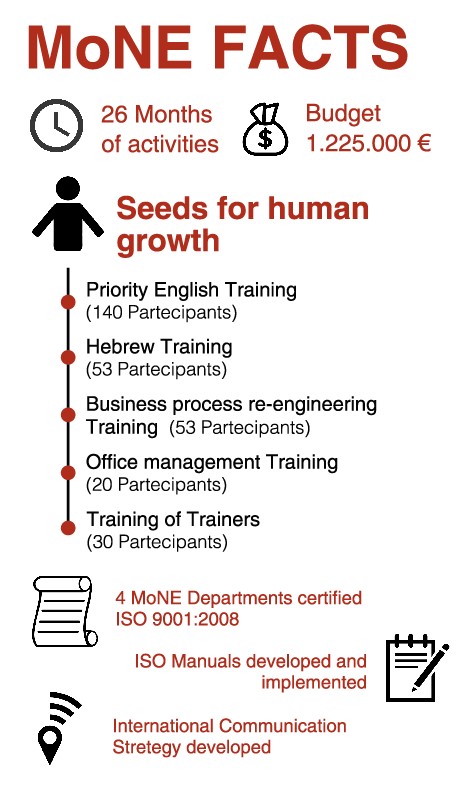
The quality system put in place by Eurecna has been also certified according to ISO 9001 standards in 4 MoNE Departments. This certification was not foreseen in the terms of references of the project: Eurecna indeed decided to go beyond project requirements in order to improve the organizational system and reward MoNE staff for the great support and cooperation in the implementation of project activities.
Elements of transferability
Action Learning approach
As the project evolved from an early diagnostic phase to its full implementation, the services provided by the technical assistance evolved from the preparation of technical documentation to a concrete ‘hands – on’ support to MoNE colleagues through an Action Learning approach.
“Action Learning” has been understood:
- as a method for individual and organization development;
- based upon small groups of colleagues working over time to tackle real problems or issues in order to get things done; reflecting and learning with and from their experience and from each other as they attempt to change things.
Against this background, the technical assistance team did not limit itself to the production of the technical reports, although contractually foreseen as required deliverable at the end of the process. If not implemented in the daily life of an organisation, technical reports would sit on someone’s desk; the aim of the TA team was to be the promoter of change by supporting MoNE in implementing the change.
We have worked closely with the beneficiary throughout the life of the programme on an Action Learning basis to ensure that the words in the reports are translated into concrete actions.
Sustainability report
By building and developing capacity within MoNE over the course of the Capacity Building Programme, the Technical Assistance (TA) team has worked to build solid foundations to guarantee the project full realization and its growth and development at the end of EU funding.
The sustainability report has aimed to work as a compass to ensure that the achievements of the Capacity Building programme continue to guide the Ministry’s on-going organizational development.