
The gap between supply and demand for skills
When the Technical and Vocational Education and Training (TVET) Programme started the Government of Egypt faced a double challenge: absorbing the considerable amount of new entrants in the labour market every year (about 700,000 to 900,000) and providing Egyptian companies with the necessary skills to grow locally and compete internationally.
The TVET system structure was scattered over more than 20 ministries and other institutions; the line ministries were committed to directly take care of the manpower needed in their respective state enterprises.
Overall, the system was not able to deliver quality skills to the market but, at the same time, most companies had great difficulties in translating their economic development plans into needs for training and skills.
There was a clear need to effectively link the two main actors: TVET providers and companies.
The public-private partnership approach
The solution identified by the TVET programme was to establish sector based Enterprise TVET Partnerships (ETPs) that could bring together private and public TVET providers, private and public enterprises, local authorities, governmental agencies, and provide decentralised and demand driven Public Private Partnership (PPP) TVET infrastructure.
The mission of ETPs was to: (i) identify new vocational profiles, skill sets and training needs; (ii) develop appropriate training programmes for existing and new staff; (iii) support the development of TVET providers and co-ordinate the delivery of training modules; and (iv) provide recommendations for a more fundamental long-term reform of the national TVET system.
The first ETP was piloted in the Ready Made Garment sector and eleven more followed further to adjusting to the specifics of the sectors.
The Project: from a supply to a demand driven TVET system
 In February 2007, a consortium led by Eurecna and comprising Megacom (Egypt), Mid Yorkshire Chamber of Commerce (United Kingdom), and Navigator (Greece), started the implementation of the €7.5m EU funded project Assistance to the Reform of the Technical Vocational Education (TVET) system in the Arab Republic of Egypt for establishment and operation of four Enterprise TVET Partnerships (ETPs) which came to an end in June 2012.
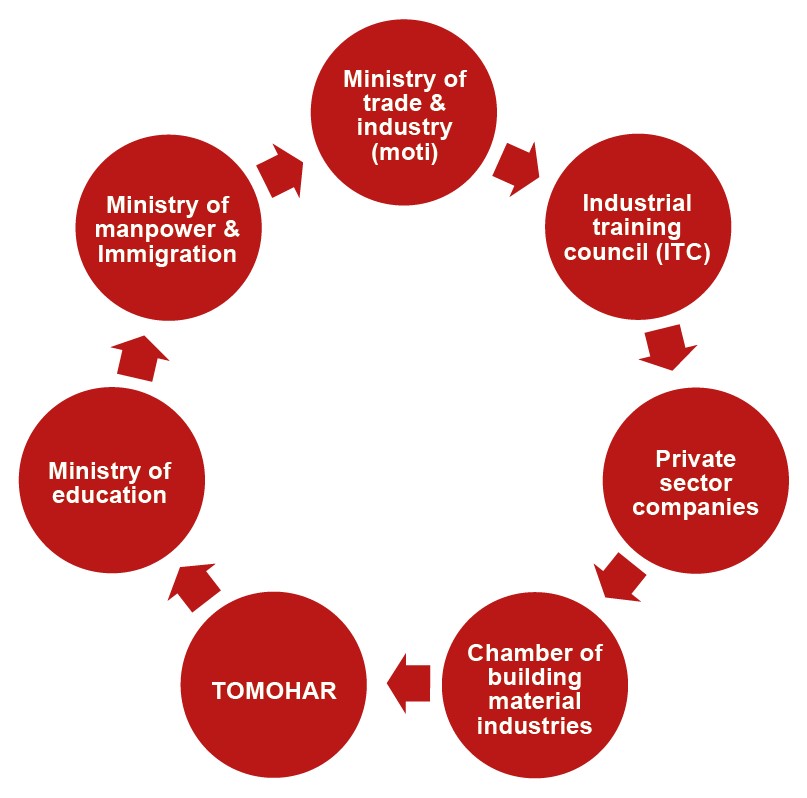
The project targeted four industrial sectors namely: engineering, building and construction materials, food processing, and wood and furniture. The project was part of a larger programme aimed at radically reforming the EgyptianTVET infrastructure from a supply to a demand driven system by:
- Establishing and reinforcing four sector based Enterprise-TVET partnerships (ETPs)
- Strengthening the capacity of TVET institutions, key policy and decision-makers, and firms to design and implement the TVET reform
- Mainstreaming the ETPs experiences as a bottom up approach into the reform of the national TVET policy
Achievements

We established four sustainable sectorial Enterprise TVET Partnerships (ETP) who are able to act – and be recognised – as strong players in the TVET system.

We developed 51 Occupation Profiles:
– 8 in the Engineering sector;
– 22 in the Building & Construction Materials sector;
– 20 in the Food sector;
– 1 in the Wood & Furniture sector.

We developed 197 training packages and trained the trainers: 41 training packages in the Engineering sector, 45 training packages in the Building & Construction Materials sector, 104 training packages in the Food sector, and 7 training packages in the Wood & Furniture sector.

We supported the establishment of 15 In Company Training Units.

We designed the concept of 15 Centres of Competence as sector-specific, semi-autonomous TVET service providers, strategically located in geographical concentrations of relevant industries.
Shaping the ETP model to boost TVET reform
“The main contribution of our project has been to take the concept of demand driven TVET from theory to practice by developing the Enterprise Training Partnership (ETP) model and effectively adjust it to the Egyptian context”.
This is how Mr Ahmed El Ashmawi, Team Leader of Eurecna’s project (TVET Programme Contract 2) chose to summarize our contribution to the efforts of the TVET programme.
In 2016, five years after the end of the programme, ETPs have been institutionalized in the Egyptian TVET system and still play a key role. ETPs are not “just” another player in the national TVET system. They are much more. They are bridges connecting market demands with the supply of specialized skills. They are catalysts of future market needs and springboards for new occupational profiles.
Yet, in hindsight, at project inception the concept of ETPs was not clearly defined and we faced the genuine risk of creating only one more player with a questionable potential impact, in the TVET system.
We immediately reckoned that we needed a concept whereby the legal form of ETPs reflected their mission. The NGO status chosen for the first ETP did not seem suitable especially because of the presence of private and public sector on the ETP boards. Our analysis of international TVET systems showed that partnership-based governance triggers higher levels of effectiveness and efficiency by essentially matching supply and demand, enabling enterprises to obtain the skills necessary for growth and enabling trainees to go on into worthwhile employment.
We shaped a new model based on the international experience of sector skills councils in the UK, enterprise centers in the Netherlands and sector skills organisations in South Africa, but adjusted these solutions to the Egyptian context, which has a dominant public sector presence in TVET on the supply side. ETPs have been designed as autonomous, legally recognized entities ensuring that employers take a leading role in shaping TVET reform in the sector through a unique Public-Private- Partnership (PPP). “This structure put the employers in the driving seat of reform”, said Mr. Amr Fathy, Key Expert for Institution Building in the Wood and Furniture ETP. At the same time, the presence of the public TVET providers ensures a balance between short-term solutions and long-term mechanisms.
This revised model needed a suitable legal status enabling ETPs to be fully recognized as an independent entity and a credible player in the TVET system. We recommended a PPP Legal Structure, tailor-made to make ETPs become the forum where private sector employers partner with public and private TVET providers and share their ideas in order to progressively transform the TVET system at a sector level.
We advocated for official recognition and finally the ad hoc PPP status of ETPs was approved by a formal Ministerial Decree in 2010.
Today, the TVET sector in Egypt is still a priority for the government and is receiving significant government and donor funding. ETPs are in a position to play an important role in facing the many challenges ahead.
Strengthening and expanding the ETP model
At the end of 2015, the EU launched the “Support to the Technical and Vocational Education and Training Reform Programme in Egypt – Phase II (TVET II)” which is supposed to continue the work done in TVET I. The planning documents of this programme anticipate that TVET II “will work at positioning all the Enterprise TVET Partnerships (ETPs) established by TVET I within the new governance structure in order to institutionalize the engagement of employers and sectors at the policy level”. ETPs are a successful model that can be implemented in Egypt in other sectors other than the twelve sectors addressed by the TVET Programme.
The success factors to be considered can be summarized with a few key words:
Tailor-made solutions
demand driven
ppp
(public-private-pertnership)
Finally, the Egyptian ETP model could also be replicated in other countries in the Middle East as a tool that successfully addresses the gap between supply and the demand for skills.